
This blog post has been researched, edited, and approved by John Hanning and Brian Wages. Join our newsletter below.
Frequently Asked Questions
What makes a cost segregation study audit-ready?
An audit-ready cost segregation study should be detailed, engineering-based, properly documented, and supported by clear cost analysis, asset classifications, methodology, and exhibits.
Does a cost segregation study need to be engineering-based?
A high-quality study should use an engineering-based approach when possible. That means the study reviews the actual property, project documents, construction details, and building components instead of relying only on broad estimates.
What documentation should support a cost segregation study?
Useful documentation may include drawings, invoices, construction records, purchase documents, fixed asset schedules, depreciation schedules, photos, cost reconciliations, and notes explaining asset classifications.
Why does study quality matter?
Study quality matters because a weak report may be harder to support if reviewed. A stronger report helps the property owner, CPA, and tax advisor understand how the conclusions were reached.
Not all cost segregation studies are built the same.
A property owner may receive one report that is detailed, engineering-based, and well documented. Another may look more like a basic estimate with broad percentages and limited support.
That difference matters.
A cost segregation study can create meaningful depreciation benefits, but the quality of the study is important. If the study is ever reviewed, the report should be able to explain what was classified, why it was classified that way, and how the costs were supported.
The IRS Cost Segregation Audit Techniques Guide is used by examiners when reviewing cost segregation studies, and it outlines the importance of methodology, documentation, cost analysis, and a clear report structure.
Why “Audit-Ready” Matters
A cost segregation study is not just a report that reclassifies assets.
It is support for a tax position.
That means the study should be able to stand on its own if a CPA, advisor, or examiner needs to understand how the results were reached.
A good report does more than say, “Here are the numbers.”
It explains the property, the methodology, the documents reviewed, the cost allocations, and the reasoning behind the classifications.
That is what separates a quality study from a basic report.
Engineering-Based vs. Basic or Automated Reports
A basic or automated report may rely heavily on estimates, assumptions, or general percentages.
That does not always tell the full story of the property.
An engineering-based study looks more closely at the actual building and its components. It may review drawings, invoices, contractor records, site details, photos, cost schedules, and other project documents.
This matters because two properties with the same purchase price can have very different depreciation opportunities.
A restaurant, medical facility, manufacturing building, apartment property, and office building may all have different systems, finishes, site improvements, and specialty components.
A quality cost segregation study should reflect the actual property, not just a generic model.
What Documentation Should Be Included?
Documentation is one of the biggest differences between a stronger study and a weaker one.
A quality study should usually include support such as:
- Purchase agreements or closing statements
- Construction invoices
- Contractor pay applications
- Architectural or engineering drawings
- Fixed asset schedules
- Depreciation schedules
- Photos or site review notes
- Cost reconciliations
- Asset classification schedules
- Notes on assumptions and methodology
Not every project will have every document.
But the study should clearly show what information was used and how the conclusions were reached.
If the report makes a classification, it should be able to support it.
Why Cost Reconciliation Matters
Cost reconciliation is one of the most important parts of an audit-ready study.
In simple terms, the numbers in the study should connect back to the actual costs.
That may include the purchase price, construction costs, invoices, contractor applications, or the fixed asset schedule.
Without reconciliation, it can be hard to tell whether the study is based on real project costs or rough estimates.
That creates problems for the property owner and the CPA.
A good study should make the math easy to follow. It should show how total costs were reviewed, allocated, and classified.
Why Methodology Matters
The IRS guide discusses different approaches and methodology for cost segregation studies, including the quality of the data and procedures used.
For property owners, the plain-English version is this:
How did the study get from the building to the final numbers?
A quality report should explain whether the preparer reviewed documents, performed a site visit or site analysis, used construction data, reviewed drawings, reconciled costs, and classified assets based on accepted tax guidance.
The methodology should not be a mystery.
A report that says “trust us” is not as useful as a report that shows the work.
What Should the Final Report Include?
The IRS Cost Segregation Audit Techniques Guide describes principal elements of a quality cost segregation report, including a summary, narrative, asset schedules, cost schedules, engineering procedures, assumptions, preparer information, and supporting exhibits.
For a property owner, that means the final report should be organized and complete enough for someone else to review.
A strong report may include:
- Executive summary
- Property description
- Scope of the study
- Methodology used
- Documents reviewed
- Asset classification schedules
- Direct and indirect cost schedules
- Cost reconciliation
- Photos or exhibits
- Assumptions and limitations
- Preparer credentials or certification
The report should not only give the result. It should explain the path to the result.
Common Red Flags in a Weak Study
A cost segregation study may deserve a closer look if it has limited documentation, broad percentages, unclear methodology, or no connection to actual project costs.
Other red flags may include:
- No clear property description
- No explanation of documents reviewed
- No asset-level detail
- No cost reconciliation
- No support for classifications
- No discussion of assumptions
- No photos, exhibits, or supporting schedules
- Results that seem unusually aggressive without explanation
A short report is not automatically wrong.
But if the study cannot explain how it reached the numbers, that is a problem.
How Specialty Tax Group Helps Property Owners
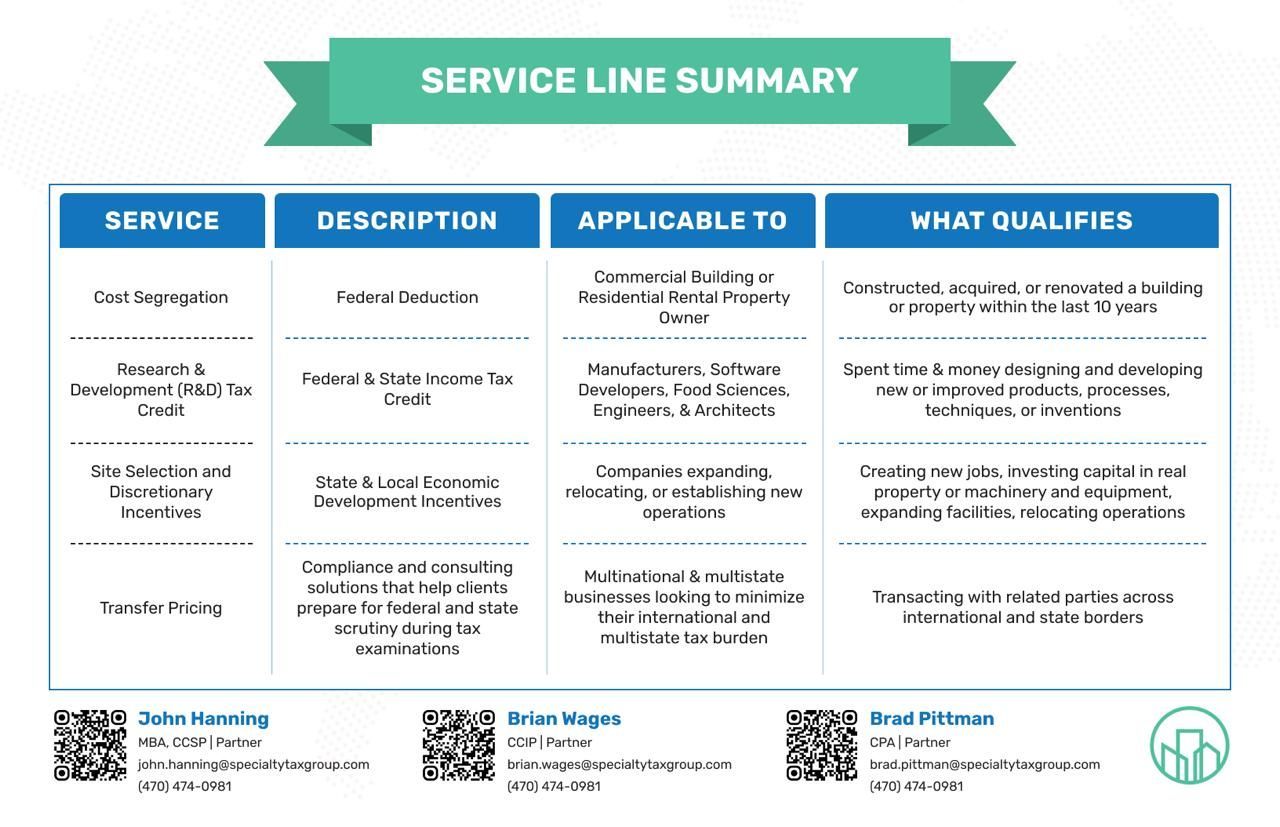
Specialty Tax Group helps property owners evaluate cost segregation opportunities with the documentation and support needed for a strong study.
That means reviewing the property, project records, cost basis, building components, and tax situation before making recommendations.
STG’s approach is focused on helping property owners understand what can be separated, what should stay with the building, and how the study should be supported.
The goal is not just to produce a report.
The goal is to produce a study that is clear, defensible, and useful for the property owner and their tax team.
Final Takeaway
A cost segregation study should do more than create depreciation numbers.
It should explain how those numbers were reached.
An audit-ready study is detailed, documented, engineering-based, and tied back to the actual property costs. It should include clear methodology, cost reconciliation, asset classifications, assumptions, and supporting exhibits.
If you are comparing cost segregation providers, the quality of the study matters.
Specialty Tax Group can help property owners complete cost segregation studies that are built with the documentation, methodology, and support needed for a stronger tax position.
2026 Tax Guide