
This blog post has been researched, edited, and approved by John Hanning and Brian Wages. Join our newsletter below.
Frequently Asked Questions
How much is the Georgia Retraining Tax Credit per employee?
The credit is equal to the lesser of 50% of retraining costs or $500 per employee per approved program, with a maximum of $1,250 per employee per year.
Do I need approval before claiming the credit?
Yes. Training programs must be reviewed and approved by the Technical College System of Georgia and completed with proper documentation.
Can management, safety, or soft skill training qualify?
No. Training must be tied to newly implemented software or technology, upgrades, updates, and new releases of software, and newly purchased equipment
Can unused credits be carried forward?
Yes. Credits can be carried forward for up to 5years.

Most businesses focus on federal tax strategies.
But one of the most overlooked opportunities sits at the state level, and it’s already happening inside your operations.
The Georgia Retraining Tax Credit rewards businesses for retraining existing employees when new equipment or technology is introduced.
What the Georgia Retraining Tax Credit Actually Covers
This credit applies when your business retrains existing employees to adapt to:
- Newly installed equipment
- Newly implemented software & technology
- Updates, upgrades, and new releases of software
How the Credit Actually Works
The Georgia Retraining Tax Credit is calculated as the lesser of:
- 50% of direct retraining costs, or
- $500 per employee, per approved training program, per year
The total credit cannot exceed $1,250 per employee per year, even if multiple approved training programs are completed.
There are also two important limits:
- It can only offset up to 50% of your Georgia income tax liability
- Any unused credit can be carried forward for up to 5 years
This turns training from a sunk cost into a measurable tax strategy.
Who Actually Qualifies
Not every employee is eligible.
To qualify, employees must:
- Be Georgia residents
- Work at least 25 hours per week
- Be employed for at least 16 consecutive weeks
- Be front-line employees or immediate supervisors
Executives, upper management, partners, and roles above first-line supervisors do not qualify.
What Training Qualifies And What Doesn’t
What Qualifies
Training must directly relate to new systems, equipment, or technology being introduced into your business.
Examples:
- Training employees on newly installed manufacturing equipment
- Implementing a new internal technology system and retraining staff to use it
- Transitioning to a new software platform
What Does NOT Qualify
The state is very specific on exclusions.
These typically do not qualify:
- Soft skills or leadership training
- Training on commercially available, mass-produced software (such as word processing, spreadsheets, email, or basic operating systems)
- Safety or compliance training
- Certification or continuing education courses
- Cross-training on systems already in place
If the training is not clearly tied to newly implemented equipment or technology, it generally will not qualify.
What Costs Can Be Included
Only direct retraining costs are eligible.
This includes:
- Instructor wages
- Employee wages during training are limited to the time spent in training while not producing goods or providing services
- Training materials and manuals
- Program development costs
- Instructional media
- Equipment used solely for training
- Reasonable travel costs
What’s excluded:
- Training space
- Sales tax
- Any training paid for by employees
State Approved Credit
To claim the credit, the training program must be:
- Submitted to the Technical College System of Georgia (TCSG)
- Reviewed and approved
- Supported with defined objectives, materials, and documentation
The Technical College System of Georgia reviews each program to determine eligibility, documentation completeness, and compliance before issuing approval.
Training programs are preferably approved in advance of implementation, though approval is required before claiming the credit.
After training is completed, a program completion form and supporting documentation must also be submitted before claiming the credit.
Why Most Businesses Miss This Credit
It’s not because they don’t qualify.
It’s because:
- They don’t know about this program
- They think that they don’t qualify
- They think their CPA handles this for them
So the activity happens, but the credit never gets captured.
How This Fits Into Your 2025 Tax Strategy
This credit works best when it’s planned, not discovered later.
When aligned with strategies like:
- Cost segregation
- Depreciation planning
- R&D Tax Credits
- Other state and federal credits
…it can lead to:
- A dollar-for-dollar tax credit
- Improved cash flow
- Better visibility into operational investments
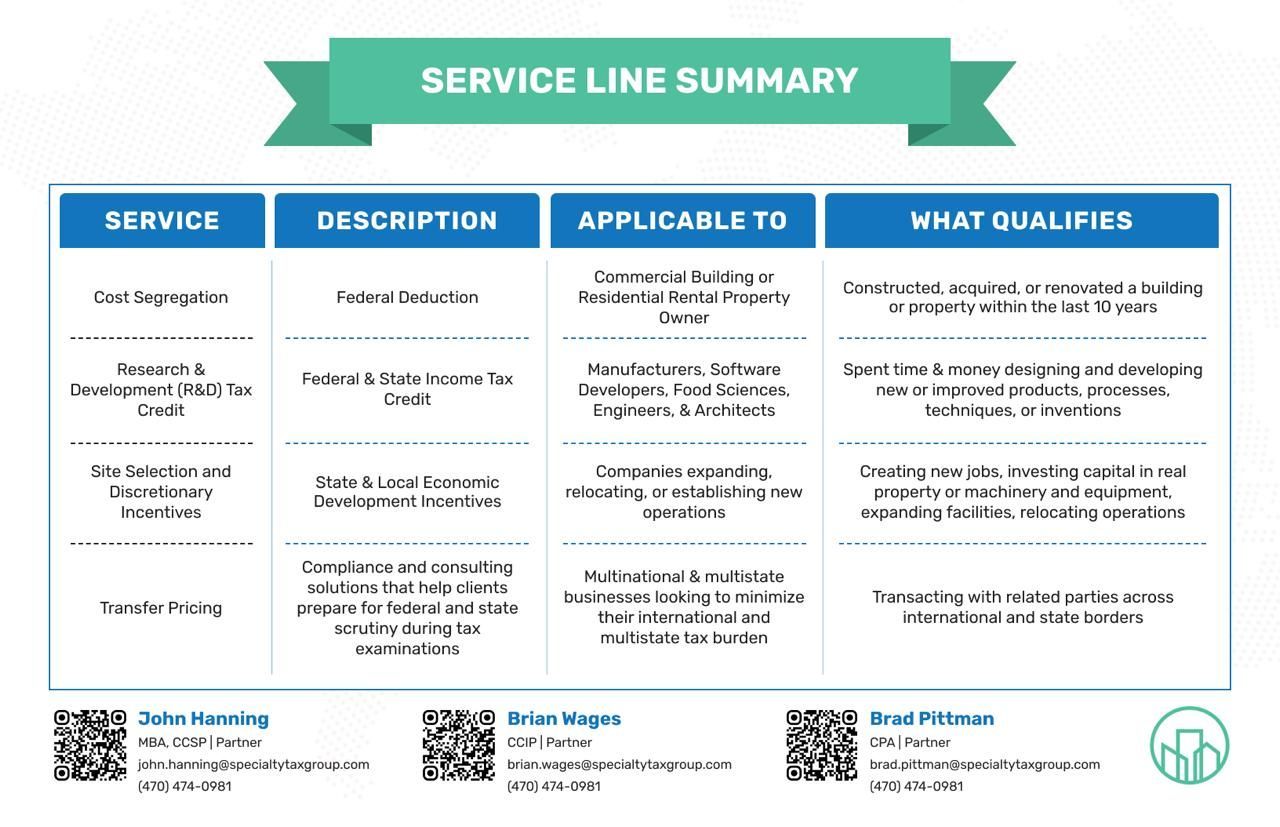
Where Specialty Tax Group Fits In
This is not a plug-and-play credit.
It requires:
- Identifying qualifying training
- Structuring programs correctly
- Navigating approval requirements
- Coordinating with your broader tax strategy
Specialty Tax Group helps businesses turn everyday operational activity into documented, defensible tax savings.
If You’re Training Employees, This Should Be in Your Plan
If your business is implementing new systems or equipment and retraining employees, you already qualify.
If you want to evaluate this,
Specialty Tax Group
can help you identify, structure, and claim the opportunity.
2026 Tax Guide